AI News · Hot news ·
AMD says Helios AI server racks will ship soon
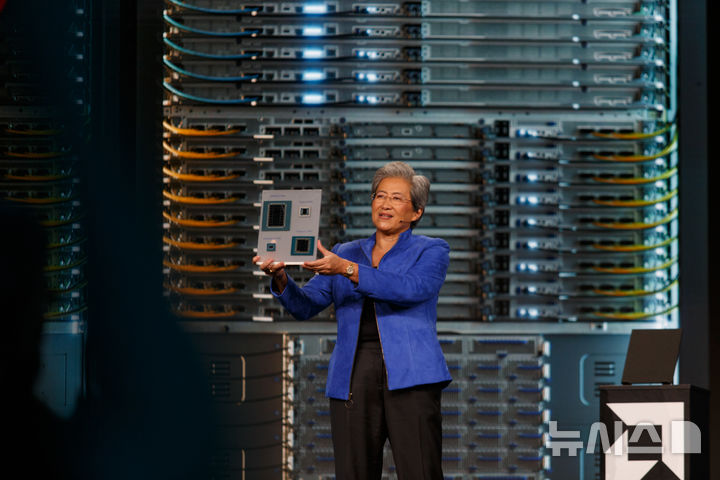
AMD's CEO said the company will soon ship Helios, a complete AI server rack combining Venice with its MI455X GPUs in one cabinet. The announcement comes as growing AI agent workloads renew attention on CPUs alongside accelerators. AMD's data center revenue reached $6.7 billion in the quarter ending in June, more than doubling year over year and accounting for roughly 60% of total revenue.
Key points
- AMD CEO Lisa Su said Helios AI server racks will ship soon.
- Helios combines Venice CPUs and MI455X GPUs in one cabinet.
- AI agents require CPU resources to execute tasks alongside GPU-based model calculations.
- AMD’s quarterly data center revenue reached $6.7 billion, more than doubling year over year.
- Exact shipment timing, pricing and detailed Helios rack specifications were not reported.
What happened: AMD will soon ship Helios, a complete AI server rack that combines its Venice server CPU with MI455X GPUs in one cabinet, CEO Lisa Su said, according to Newsis. Su unveiled the system at the company’s Advancing AI 2026 conference in San Francisco. The rack brings together two types of processors with different roles in AI computing. An exact shipment date, pricing and detailed rack specifications were not reported.
The details: Helios arrives as AI agents draw renewed attention to CPUs, the processors that execute many everyday computing tasks. GPUs handle the complex calculations used to train AI models and generate responses. Agents go further than answering questions: they can launch programs, move files and carry out multistep jobs over hours or days. Those activities require CPU resources alongside the GPUs running the models. Newsis, citing CNBC, reported that growing agent use is creating fresh opportunities for AMD’s and Intel’s CPU businesses.
Background: AMD already has a substantial presence in data centers, selling both CPUs and GPUs. Its data center revenue reached $6.7 billion in the quarter ending in June, more than doubling from a year earlier and representing roughly 60% of total revenue, Newsis reported. That business includes both processor categories, so the figure does not isolate demand for agent workloads or Helios. Intel and AMD CPUs are widely used in servers at Amazon, Google, Meta and Microsoft, while AMD’s x86 processors offer compatibility with existing software.
Who it affects: For business teams evaluating AI infrastructure, the announcement puts complete systems, rather than GPU specifications alone, in focus. CPU capacity matters when agents must execute work after a model decides what to do. Newsis reported that Meta and OpenAI use virtual machines, which divide a server into multiple virtual computers, to run many users’ agents simultaneously. Some AMD EPYC processors have up to 192 CPU cores. That illustrates AMD’s broader server offering, but the report did not specify Helios’s CPU core count or agent workload performance.
What to watch: AMD faces widening competition across both processor categories. Arm has introduced a CPU aimed at AI agents, with Meta as its first customer, and Nvidia has unveiled its Vera CPU for agent workloads, Newsis reported. Major cloud companies are also expanding development of their own CPUs using Arm technology. For prospective Helios buyers, the next questions are when racks will become available, what configurations will be offered and how the complete system performs on their workloads. Those details were not reported.
Our take
Teams evaluating AI infrastructure should compare complete systems rather than GPU specifications alone. Agent workloads also make CPU capacity an important part of procurement planning.