AI News · New apps ·
Astribot showcases T1 humanoid robot in North America for the first time
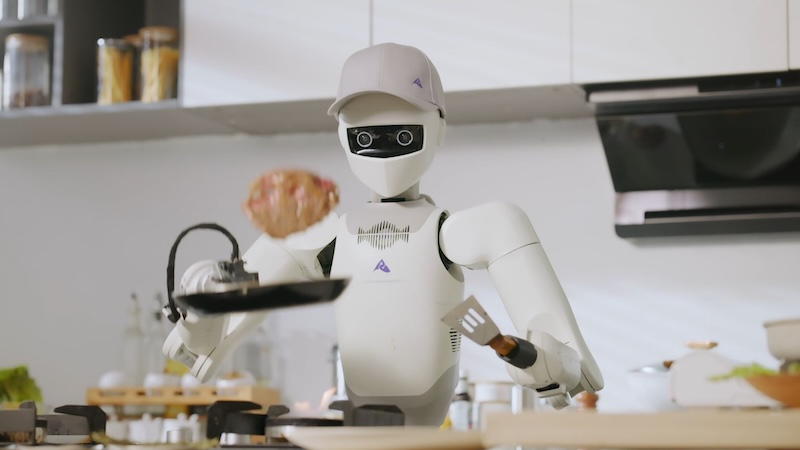
Shenzhen-based physical AI company Astribot showcased its T1 humanoid robot in North America for the first time at IROS 2026. The conference ran from September 27 to October 1 in Pittsburgh, Pennsylvania. Astribot used the event to demonstrate its integrated approach to physical AI.
Key points
- Astribot made T1’s North American debut at IROS 2026 in Pittsburgh.
- US pricing starts at $18,000, with orders open and immediate delivery reported.
- T1 combines Lumo AI models, Astribot OS and a modular cable-driven body.
- Additional task capabilities require further training; T1 does not learn autonomously in real time during deployment.
- Independent reliability testing and sustained customer deployment results were not reported.
What happened: Astribot, a Shenzhen-based physical AI company, showcased its T1 humanoid robot in North America for the first time at IROS 2026, Robotics and Automation News reported. The conference ran from September 27 to October 1 at the David L. Lawrence Convention Center in Pittsburgh, Pennsylvania. The company used the event to present an integrated approach to physical AI, combining AI models, an operating system and a cable-driven robotic body. The report also said US customers can order T1 now, with pricing starting at $18,000 and immediate delivery available.
The details: Astribot calls its approach “Design for AI”: intelligence, software and hardware are developed as one system rather than adding AI to an existing robot. Its Lumo model family is designed to connect reasoning with physical action. Equipped with the Lumo-2 base model, T1 has demonstrated autonomously packing miscellaneous objects into a backpack, combining decision-making with manipulation of deformable objects. Astribot is developing Lumo-2 for more complex household tasks, but additional capabilities depend on further training. The demonstration therefore shows a specific capability, not evidence that the robot can already handle a broad range of household work.
Who it affects: T1 is positioned as a platform for researchers, developers and real-world applications. Developers can use SDKs and APIs to access joint control, movement in Cartesian coordinates, whole-body coordination and sensor data. Astribot OS adds software packages and skill libraries for building robot behaviors. Its natural-language interface is designed to turn a single-line requirement into a deployable robot application. According to the company, 15 teams developed and demonstrated more than ten functional T1 applications in 36 hours at its second OS hackathon, which concluded September 21 in Beijing.
The details: The robot stands approximately 1.55 meters tall, weighs about 66 kilograms and supports up to 5 kilograms of payload per arm. It has 23 degrees of freedom, excluding its end effectors, the tools attached to perform tasks. T1 supports automatic charging and quick battery replacement. Its modular design accommodates different end effectors, computing modules and sensors, while VR-based teleoperation gives users another way to operate it. Astribot says its cable-driven architecture is designed to support dexterous manipulation, compliant interaction and high-speed movement.
What to watch: T1 does not learn autonomously in real time during deployment. Astribot instead collects data from robot operation and teleoperation, processes it, retrains models and installs updated skills through over-the-air updates or on-site installation and calibration. Customers can choose data collection for dedicated training or during autonomous task execution. For business teams, the North American showcase introduces another platform to assess, with ordering and pricing already reported. However, independent reliability testing and sustained customer deployment results were not reported. Commercial availability and a conference demonstration do not, on their own, establish readiness for a particular workplace.
Our take
The showcase introduces another humanoid platform for North American teams to assess. A conference demonstration alone does not establish commercial availability or deployment readiness.