AI News · New apps ·
Manus launches Cue agents with their own email, phone and wallet
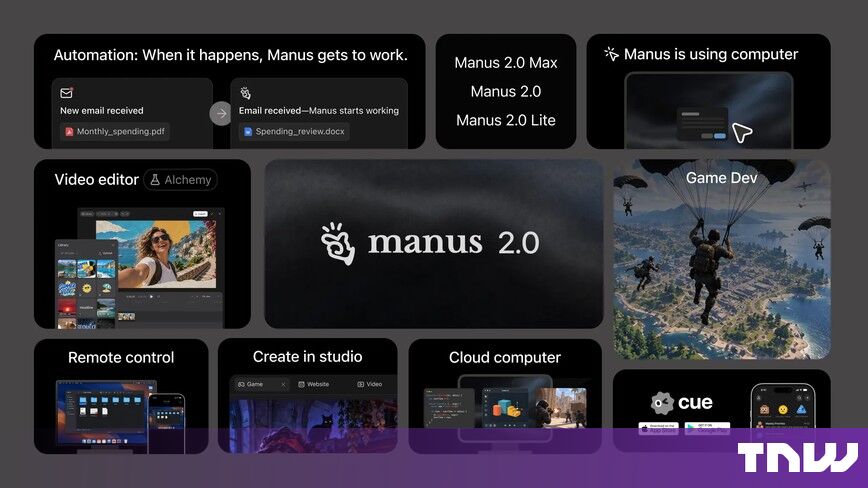
Manus launched Manus 2.0 and Cue, a standalone personal-agent app in early access. According to the company, each Cue agent gets an email address, phone number, wallet and computer, and can send messages and make payments within a user-set budget.
Key points
- Cue agents get their own email address, phone number, wallet and computer, according to Manus.
- Agents can send messages and make payments within user-set budgets.
- Cue is free during early access with an invite code; iOS awaits App Store review.
- Manus 2.0 adds event-triggered Automations and the Cascade agent system.
- Payment approval details, account permission settings and pricing after early access were not reported.
What happened: Manus launched Manus 2.0 and Cue, a standalone personal AI agent app in early access, The Next Web reported. Manus, an AI agent startup founded in China and now based in Singapore, said each Cue agent gets its own email address, phone number, wallet and computer. The agents can send messages and make payments within a budget set by the user. For business teams evaluating agents, those communication and payment capabilities make spending limits and account permissions particularly important.
The details: Cue runs on the same infrastructure as Manus, and each agent can complete a task on its own machine, according to the company. Agents can also take users’ calls and leave an account of them in the app. Several agents can work toward a shared goal in a group chat and pass work between themselves. In Manus’s example, one researches venues for a New York launch, another prepares a shortlist and a third drafts a presentation. The company also described scanning a restaurant QR code so an agent can order or hold a place in line. Cue is free with an invite code during early access. Manus said it works on web, desktop and mobile, with iOS availability to follow App Store review.
Background: Manus 2.0 introduces Cascade, an in-house system that brings in specialised tools only when a project needs them. Manus said that, in one tested setup, Cascade used 23.2% fewer tokens, finished tasks in 28.2% less time and cost 32% less to run than its previous system. Those figures describe a company test, not a reported result across all workloads. A new Automations feature can start tasks in response to activity in connected services, including an email, Slack message, calendar event or Notion update. Previously, scheduled tasks could start only at a set time.
Who it affects: The broader release also targets teams creating and editing digital work. The desktop app becomes Manus Studio, a shared workspace for documents, spreadsheets, slides, websites, code, games and video. Its Video Editor exposes a timeline so users can manually change clips, images, text and audio. Game Dev creates games that can be published as websites and played through a link. Users can buy a Cloud Computer that continues running when their laptop is closed, while Remote Control lets them direct Manus from a phone and watch it work live on their computer.
What to watch: Cue enters a market where Meta is also pursuing personal agents. Bloomberg reported that Meta’s Muse quickly reached the top of app store charts after launching earlier this month. For Cue evaluations, the disclosed user-set payment budget is a concrete control to examine. Details about payment approvals, account permission settings and pricing after early access were not reported.
Our take
Giving agents communication and payment tools makes spending limits and account permissions central to evaluation. Start with low-risk tasks and tightly capped budgets.